


Virillio Code

Virillio LLC
Popular MCPs & plugins
 GitHub
 Slack
 Notion
 Figma
 Google Drive
 Linear
 Stripe
 Supabase
 Vercel
 Jira
 HubSpot
 Dropbox
Latest blog posts

A Coding-Agent Debugging Trace Needs a Hypothesis Ledger

A Coding Agent Needs an Assumption Register Before It Acts

Delegated Agent Work Needs a Return Contract

Tool Annotations Need a Policy Decision

A Resource URI Needs a Freshness Receipt

A Nested Model Call Needs a Delegation Contract

An Agent’s Question Needs a Decision Contract
COMET macOS 15+A little help.
A little help.
Right at the top.
Your study companion, one glance away. Bring in your page, ask a question, and put your ideas into words.
A little personality. A lot of possibility.








BIOLOGY / CHAPTER 04
Photosynthesis
Understanding how plants turn sunlight into energy.
01 STAY CURIOUS.
Move your cursor
up here.Tap to open Comet.
up here.Tap to open Comet.
Interactive demo with fictional study material and scripted replies.
Sample conversations. A sample document. A real feel for Comet.
A little space. A lot you can do.
From your first question to the words on your page.
Always within reach.
Move your cursor to the top of your Mac. Start a question or pick up a recent conversation. When you move away, Comet tucks back into place.


Work through a question.
Break an idea down, ask a follow-up, and keep your train of thought. Your conversations are right where you left them.
Bring your page with you.
Press both Option keys to bring your selected text and a screenshot into Comet. Add your question when you’re ready.
⌥optionleft+⌥optionright
Biology worksheet.png
“Plants use sunlight to make food…”
Ask about what you see.
Attach a worksheet, screenshot, or page of notes. Get help with the part you’re looking at.
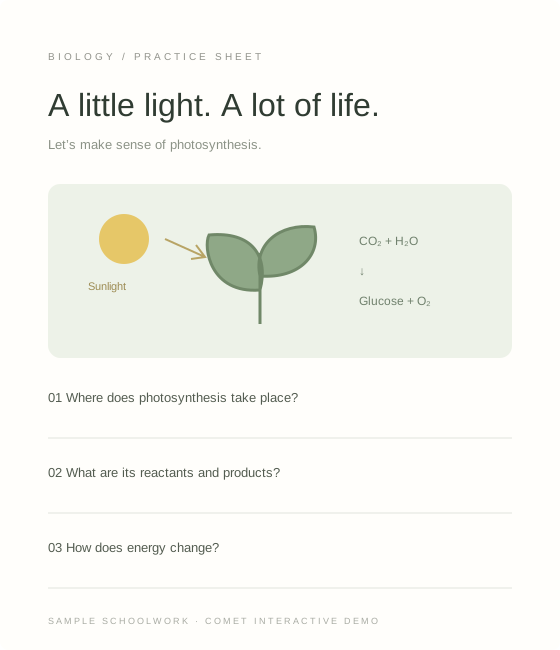
Put it into words.
Choose a place in your document and turn on Add to app. Your finished response appears right where you need it.
How does photosynthesis work?
Photosynthesis turns light energy into chemical energy. Plants use sunlight, water, and carbon dioxide to make glucose, releasing oxygen along the way.
Added to your document
Add to app
A second pair of eyes.
Review your original writing alongside a correction. Replace it, copy it, or keep your words as they are.
Fix grammar
ORIGINALPlants uses sunlight to make food.
This process help them grow.
Plants use sunlight to make food.
This process helps them grow.
CancelCopyReplace
Prepare once. Paste in order.
Edit and arrange your answers, then press Control + Shift + V to insert them one at a time.
Prepare pastes 3 answers
1
Chloroplasts contain chlorophyll, the pigment that absorbs light energy.
2
Carbon dioxide and water are the reactants. Glucose and oxygen are the products.
3
Light energy becomes chemical energy stored in glucose.
⌃⇧V
NEURALESEA little more room
A little more room
for your day.
Conversations, companions, and your next good idea. A familiar space, on your phone and your desktop.
Ask. Plan. Make it yours.
Try a conversation, explore your calendar, or meet a companion in the preview below.
Chat
A little help
with your day.
Chat
A little help
with your day.
Helpful Widgets

Read a chapter
Ready to talkSage